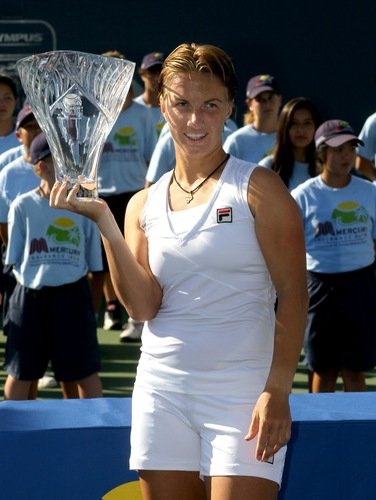
The Mercury Insurance Open at San Diego is a 56 entrant premier level event. The winner of the tournament will receive 111,000 dollars and 470 ranking points. The draw came out last night, and it didn't disappoint. Although Kim Clijsters, Petra Kvitova and Svetlana Kuznetsova withdrew, there are still some big names coming to the Mercury Insurance Open. The top seed at San Diego will be Vera Zvonareva, the third ranked player in the world.
Read on for my analysis of the contenders for the title and for some possible matchups.
The Citi Open at Washington DC is an international event happening next week. It is not part of the US Open series. Although the tournament may seem pretty lackluster with no players in the top 20, there are still some interesting stories to be told here. I hope you take the chance and read on.
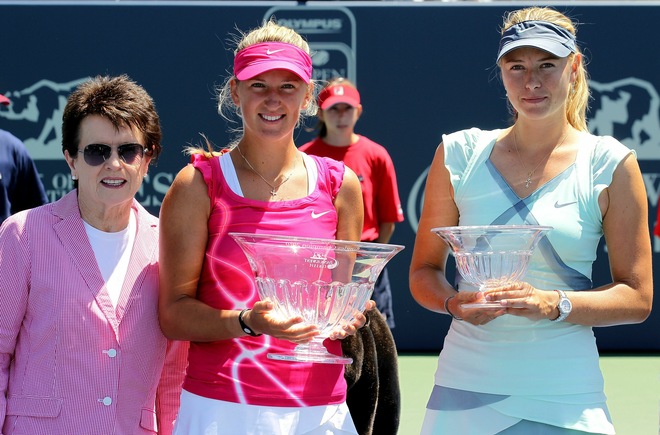
The Bank of the West Classic at Stanford is the first event of the US Open Series for the WTA. It is a premier event that will feature four members of the top ten as well as six more players in the top 32. Serena Williams will also be competing in Stanford. Last year at Stanford, Victoria Azarenka beat Maria Sharapova in the finals, 6-4 6-1. Will Azarenka be able to defend her championship and capture her third singles title of the year?
The US Open Series is a series of five premier events for both genders. The WTA US Open series begins next week with Stanford and ends with New Haven. The two biggest events of the US Open Series are at Cincinnati and Toronto. Although the US Open Series is a great way to warm up for the US Open in late August, there is another bonus to doing well here- the top three finishers in the US Open series will win an extra million dollars in prize money if they win the US Open.
The Hawkeye system was put in place so that players could challenge calls that they felt were incorrect. It came partially as a response to the US Open quarterfinal match between Serena Williams and Jennifer Capriati. During that match, Serena had a series of blatantly incorrect line calls made against her.
I think that the challenge system is great. Players get three incorrect challenges per set and an extra challenge in the tiebreak. In matches where tiebreaks aren't played in the final set, players get their incorrect challenge tally reset. However, there are some problems with the challenge system that should be addressed.
The first one is the amount of time taken before a challenge is made. Oftentimes, players spend a large chunk of time deciding whether they should challenge or not. Sometimes, players even look towards their box to see whether they should challenge or not. Other times they spend close to thirty seconds debating with the umpire before challenging. This should not be allowed. A player should have less than three seconds to signal that they want to challenge. Otherwise, the challenge system becomes a form of legal time delay.
During Wimbledon, I've noticed that many players are challenging close balls after they make errors. I don't know why umpires allow the players to challenge. A player should not be given two opportunities to win a point. I understand that a player might be in the middle of their stroke when they notice that the shot they are returning is out. However, when a player hits a shot, realizes that their shot is out, then challenges, they should not be allowed to challenge.
That brings me to the recent tennis scandal known by tennis fans as "Kadergate."
During Doha 2011, Agnieszka Radwanska was playing a match against Lucie Safarova. Safarova hit a ball that was called out but then overruled. Radwanska decided to challenge and was incorrect. Kader Nouni, the umpire, gave the point to Safarova. Radwanska was quite upset because she felt that the point should have been replayed. She definitely had a play on the ball, and, if the umpire thinks that the player had a play on the ball and play is interrupted by a non-player, the point should be replayed.
However, Nouni gave the point to Safarova because Radwanska had challenged and was wrong. When a player interrupts play to challenge and the challenge is incorrect, the player is supposed to lose the point. This sort of point happens often, and most of the time, the umpire allows the point to be replayed. However, I agree with Nouni that, when a player challenges, he or she is interrupting play again and should lose the point.
Thoughts?
But besides those issues that I have with Hawkeye, I think it is a great system and should be implemented on as many courts as possible- even clay courts.